Boundary: this is a proposed control-plane architecture, not a description of a deployed AI-enhanced SFU or measured production results. Every AI component, decision loop, and evaluation step below would require validation against a specific workload.
The verified starting point
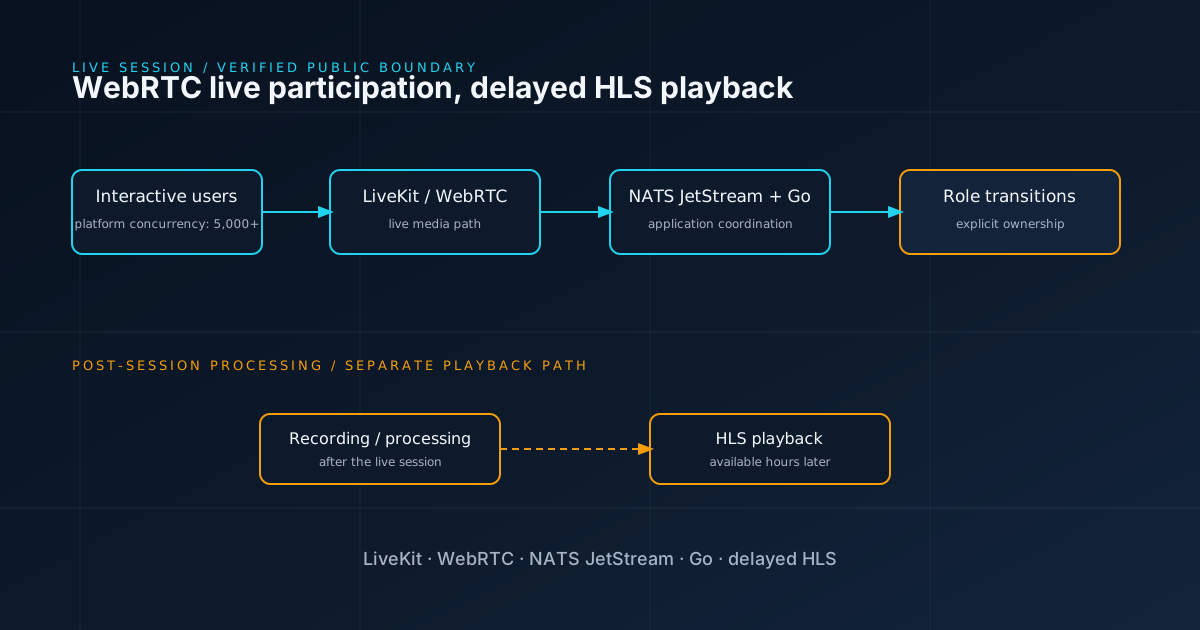
The HonarAmoozesh implementation used LiveKit and WebRTC for live interactive participation, while NATS JetStream and Go supported application coordination. HLS was a separate playback path available hours after the session. It did not provide evidence for live audience switching between WebRTC and HLS.
The verified concurrency figure was more than 5,000 users at platform level. It did not mean 5,000 publishers, one 5,000-person room, or 5,000 connections terminating on one SFU. AI was not part of that implementation evidence.
The remainder of this essay asks a different question: where could probabilistic analysis help an SFU platform without becoming a hard dependency for media delivery?
Keep the media path deterministic
A proposed design would keep packet reception, subscription authorization, layer selection, congestion response, and forwarding inside deterministic software. A model would not sit synchronously between an incoming RTP packet and its forwarding decision.
If every AI service disappeared, the SFU would continue using its normal scheduler and last safe configuration. That invariant is the first guardrail.
Separate inputs, recommendations, policy, and actions
The proposed control plane would have four explicit stages.
Model inputs
SFU and client telemetry could provide bounded observations such as packet loss, jitter, round-trip time, available bitrate, layer switches, room composition, CPU pressure, and egress behavior. NATS JetStream could transport sampled or aggregated events asynchronously so media forwarding would not wait for inference.
Model recommendations
Different operational questions would use separate models or statistical methods. A forecasting model could estimate node pressure. A classifier could distinguish likely client-network degradation from server pressure. A ranking model could recommend a region for a new room. None of those outputs would directly mutate SFU state.
Policy decisions
A deterministic controller would validate each recommendation against capacity, region eligibility, privacy requirements, room affinity, cooldowns, and a maximum change budget. It could reject an invalid recommendation, require repeated evidence, or reduce it to an operator suggestion.
Guarded actions and fallbacks
Only narrow, reversible actions would be eligible for automation. A timeout, stale recommendation, low-confidence result, or unavailable model would fall back to deterministic placement and adaptation rules. Hysteresis and rate limits would prevent repeated room movement or layer oscillation.
Keep media intelligence on a separate branch
Transcription, moderation, scene analysis, and caption generation require decoded media or a suitable derived stream. A proposed implementation would send only selected streams to dedicated workers, with explicit consent, retention, and resource policies. These workloads should not be described as free metadata processing inside a non-decoding SFU.
Evaluate decisions rather than demonstrations
A credible evaluation would begin in shadow mode. Historical telemetry could be replayed while the model produces recommendations without changing system behavior. The comparison would include deterministic scheduler choices, known incidents, operator decisions, and recommendation expiry.
A later canary could allow one low-risk, reversible action for a small population. The evaluation would need to cover missing telemetry, model timeouts, contradictory recommendations, sudden room growth, and stale node eligibility. Useful measures would describe the complete decision system: stability, rollback behavior, avoidable quality degradation, operator workload, and total cost.
No outcome is claimed here. The proposal would earn production authority only if those measurements showed an improvement over the deterministic baseline without weakening failure behavior.
Primary references
The engineering principle
AI could help an SFU platform interpret uncertainty, but it should receive little authority by default. Keep packet forwarding deterministic, move inference into asynchronous control loops, validate recommendations through explicit policy, preserve a complete fallback path, and evaluate operational decisions against a defined baseline.